Pietra d'inciampo in memoria di Bernardino Troiani
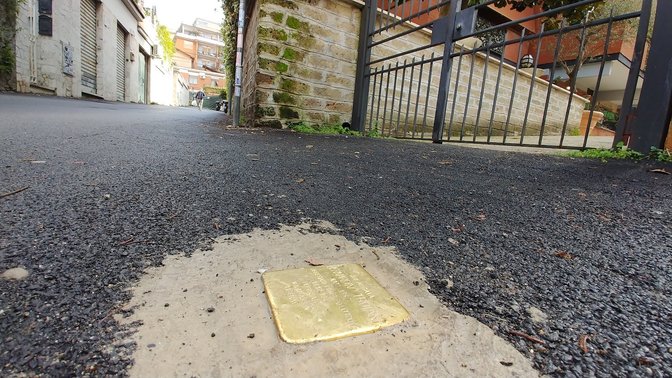
Vicolo del Vicario, 14, 00165 Roma RM
Rating: 5.0 ★ (1 rating)
Details
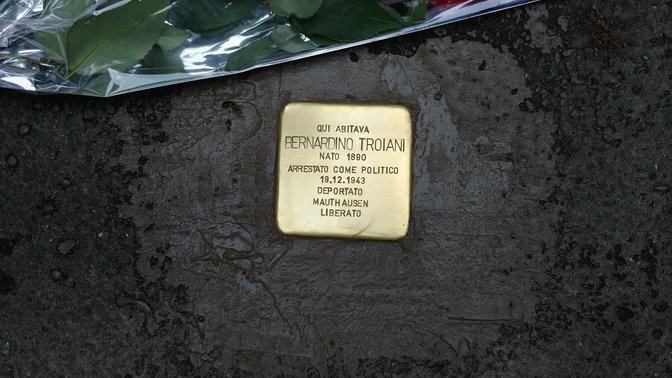
Bernardino Troiani was born in Petrella Salto (Rieti) on April 1, 1890, and lived in Rome at Vicolo del Vicario, 14 (Municipio XIII-Aurelio, Rome Capitale). His profession was bricklayer. An anti-fascist political activist, he was arrested several times and classified as a "dangerous political prisoner, Category: anti-fascist" (ACS, C.P., C, File No. 128722), assigned to Category 3 of the List of "dangerous persons to be arrested under any circumstances" contained in the Consolidated Law on Public Security in force at the time. Troiani was reported twice, in different years, to the Provincial Commission of Rome for Warnings and Confinement Provisions and was sentenced, the first time in 1934, to four years of confinement, to be served in the Ponza Colony "for having initiated an anti-fascist demonstration" (Order of the Provincial Commission of Rome of July 8, 1937, in ACS. D.G.P.S., Envelope No. 1026). In 1937, thanks to a clemency order issued by Mussolini for Christmas that year, he was pardoned for part of his confinement sentence. The order, however, caught up with him in the Poggioreale Prison (Naples), where he was held for having attacked, in September 1937, two guards from
Location
Opening Hours
Monday: Open 24 hours | Tuesday: Open 24 hours | Wednesday: Open 24 hours | Thursday: Open 24 hours | Friday: Open 24 hours | Saturday: Open 24 hours | Sunday: Open 24 hours
Contact
http://www.arteinmemoria.it/memoriedinciampo/edizione2020.htm
An anti-fascist political activist, he was arrested several times and classified as a "dangerous political prisoner, Category: anti-fascist" (ACS, C.P., C, File No. 128722), assigned to Category 3 of the List of "dangerous persons to be arrested under any circumstances" contained in the Consolidated Law on Public Security in force at the time.
Troiani was reported twice, in different years, to the Provincial Commission of Rome for Warnings and Confinement Provisions and was sentenced, the first time in 1934, to four years of confinement, to be served in the Ponza Colony "for having initiated an anti-fascist demonstration" (Order of the Provincial Commission of Rome of July 8, 1937, in ACS. D.G.P.S., Envelope No. 1026).
In 1937, thanks to a clemency order issued by Mussolini for Christmas that year, he was pardoned for part of his confinement sentence. The order, however, caught up with him in the Poggioreale Prison (Naples), where he was held for having attacked, in September 1937, two guards from the Ponza border colony who had urged him to stop railing against the Regime.
After his release in 1942, he was again reported to the Provincial Commission of Rome for Warnings and Confinement Provisions and received a second sentence of one year of confinement, to be served in the Colony of the Tremiti Islands, but this time he managed to escape arrest.
On December 19, 1943, he was arrested again by agents of the Public Security Commissioner's Office "Borgo" and the day after his arrest, he was admitted to Regina Coeli Prison (Matriculation Number 13184). From there, after sixteen days of detention, as reported in the Note from the Royal Police Headquarters of Rome No. 024647, dated May 9, 1944, addressed to the Ministry of the Interior (in ACS, C.P.C., Envelope No. 5223): "[…[". "the aforementioned was apprehended and, on January 4, 1944, sent to the North".
In reality, on January 4, 1944, Troiani was loaded, together with 319 other inmates of the Roman prison, onto Italian Railways convoy no. 64155, to be deported to the Mauthausen Concentration and Extermination Camp (Upper Austria), where he arrived on January 13 of the same year and was registered with the number 42212. Troiani was subsequently transferred to the Ebensee subcamp (codenamed "Zement" by the Nazis), where he was found still alive when the camp was liberated on May 6, 1945.