
Column of Marcus Aurelius
Trastevere, 00153 Rome, Metropolitan City of Rome Capital
Rating: 5.0 ★ (1 rating)
Details
Column of Marcus Aurelius stands majestically in Piazza Colonna, a formidable Roman victory column that dominates its central Rome setting. Erected between 180 AD and 193 CE, this impressive monument was commissioned by Emperor Commodus to honour his deified father, Marcus Aurelius. Much like Trajan's Column, it features a remarkable spiral relief, yet its distinct, deeply carved narrative lends it a unique and imposing character, setting it apart as a profound testament to ancient imperial power.
The column's most striking feature is its elaborate spiral frieze, an extensive band of carvings stretching approximately 112 metres (367 feet) that encircles the shaft 21 to 23 times. These intricate reliefs vividly depict Emperor Marcus Aurelius's military campaigns during the Marcomannic Wars against Germanic and Sarmatian tribes, showcasing over 2,000 distinct figures and scenes of battle, speeches, and even a fabled 'Rain Miracle'. While an internal spiral staircase once led to the summit, it is now closed to visitors, though the exterior details can be admired from the piazza. The column is now crowned with a bronze statue of St. Paul, having replaced the original depiction of Marcus Aurelius.
This monumental column is particularly well-suited for history enthusiasts and those with a keen interest in Roman art and military strategy. It offers a tangible connection to the ancient world, allowing visitors to ponder the imperial ambitions and artistic prowess of the Roman Empire. A visit here provides a significant historical pause, perfectly complementing a broader exploration of Rome's iconic landmarks and contributing a deeper understanding of its enduring legacy.
This is a little-known place, which I have been documenting photographically since 2018 and which, over time, I have included and reviewed, observing its changes and its hidden, melancholic location.
A place at risk of disappearing twice, first from collective memory and then even from digital maps.
I am happy to republish this story, updated and expanded, in the belief that some urban details deserve to be rediscovered and valorized.
WHERE IT IS LOCATED:
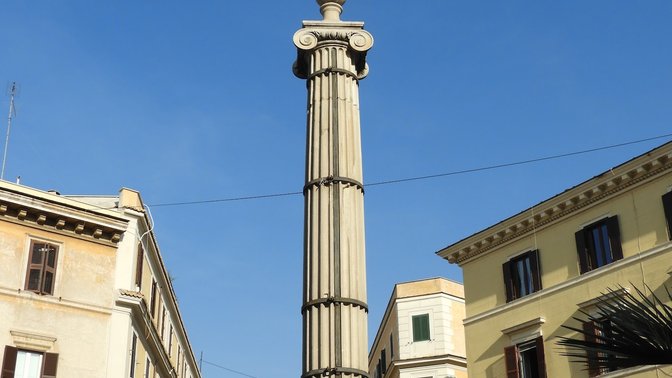
This "Roman Cruciferous Column" is located in the historic center of Rome, Rione XIII (Trastevere), in Piazza di San Francesco d'Assisi.
HISTORY BRIEF:
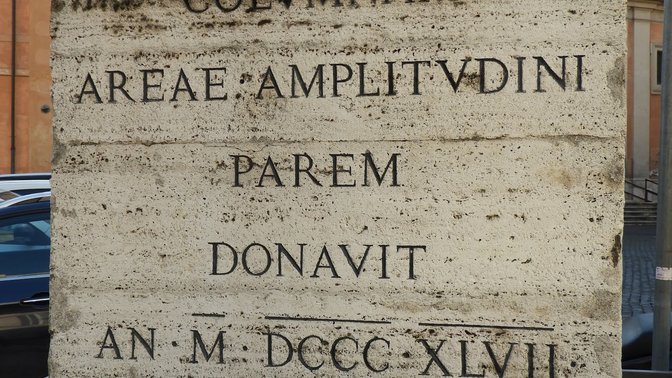
It was erected in 1847 by Pope Pius IX to replace an existing column that had fallen into disrepair. On one side of the base is a Latin inscription commemorating this event, which in Italian means: "Pius IX, Pontifex Maximus, donated a column of equal value due to the importance of the area in the year 1847."
ARCHITECTURE:
The striped Ionic column in white marble stands in the center of the square, atop a tall quadrangular travertine base. It is of great value, having come from an Augustan-era building in the Roman municipality of Veii. An artistic iron cross sits atop it.
Unfortunately, its location is unfortunate: surrounded by cars parked just inches away, it survives thanks to a series of metal columns that protect it from modern impacts and distractions.
FUN FACT: DID YOU KNOW... The square is linked to visits by Saint Francis?
According to Franciscan sources, Saint Francis of Assisi stayed in Rome several times between 1209 and 1223.
Tradition holds that the Saint stayed in the Church of San Francesco a Ripa several times during his travels, when he visited the Pope to discuss the approval of the Franciscan Rules.
The cell of the Hospice of San Biagio, which also houses some of his relics, can still be visited upon request.
A PERSONAL EXPERIENCE:
It is not marked by large tourist signs; it is a place that is encountered almost by chance, escaping the eyes of rushed tourists.
And yet, those who notice it are struck by it: it is a small artifact that speaks of a long-gone papal Rome, a time when the ancient was recovered to give dignity to new urban spaces.
Photographing it means capturing a fragment of distant eras that interact with each other: the Augustan, the Papal, and the contemporary.
IN CONCLUSION:
If this place has piqued your curiosity, let Rome continue to surprise you. Explore my other reviews to discover a secret city, made of details, emotions, and timeless wonders.