Palazzo Santacroce a Sant'Angelo
Via di S. Maria del Pianto, 60, 00186 Roma RM
Rating: 5.0 ★ (2 ratings)
Details
Palazzo Santacroce a Sant'Angelo is a magnificent Renaissance palace situated in Rome, commissioned by Earl Onofrio Santacroce and designed by the esteemed architect Carlo Maderno between 1598 and 1602. Its grand character is evident in the carefully restored 19th-century facades, which feature three floors, a mezzanine, and ornate windows adorned with stucco festoons. The palace stands out for its historical links to the influential Santacroce family, known for introducing tobacco to Italy, and its prominent position within the Sant'Angelo and Regola districts.
Within its imposing structure, visitors can appreciate the palazzo's two courtyards, though their original bas-reliefs and statues are now dispersed. A notable feature is the exquisite 18th-century fountain in the rear courtyard, showcasing a depiction of Venus rising from a shell, artfully framed by an arch supported by telamons. A smaller fountain is also found within a charming hanging garden, facing Vicolo dei Catinari. For some years, the palace served as the home for the Italo-Latin American Institute, along with a university graduate school, reflecting its capacity to host significant cultural and academic institutions.
This historic Roman residence is particularly appealing to those with a passion for Renaissance architecture and the narratives of aristocratic Roman families. It provides a unique window into the past opulence and grandeur of the city's nobility. The splendid exterior and deep historical roots make it an excellent point of interest for architectural scholars and curious tourists navigating the rich cultural landscape of Rome's central districts.
We pass the church of Santa Maria in Publicolis on our right, which houses the tomb of the Santacroce family, who built a prestigious noble palace on the same street.
After a few steps, if you look to the left, you'll see this beautiful little palace. Its main façade faces Via in Publicolis, while the tower, closely connected to the building, was built at the corner of Via di Santa Maria del Pianto.
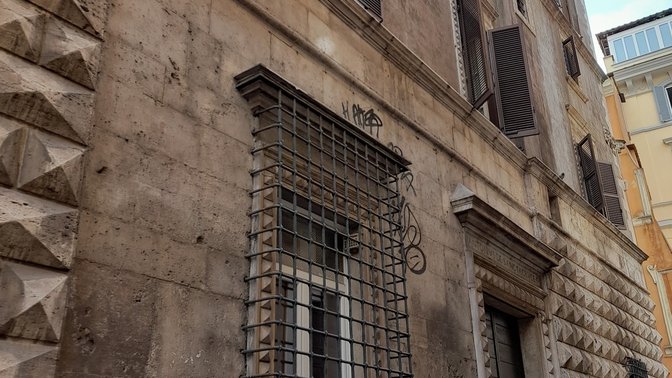
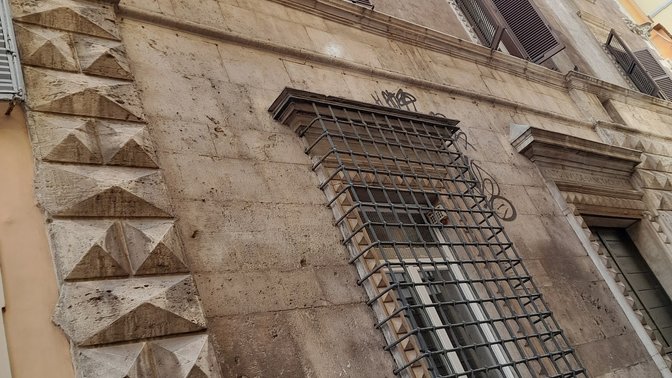
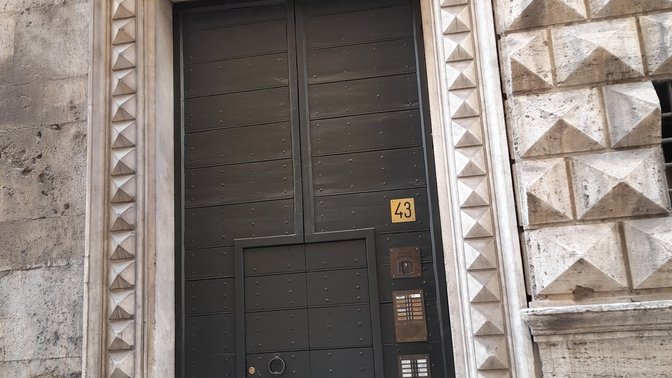
The entrance portal to the palace contains, below the architrave, the inscription in capital letters: "Antonius de Santacruce fecit," while the jambs are structured with small diamond-pointed ashlar.
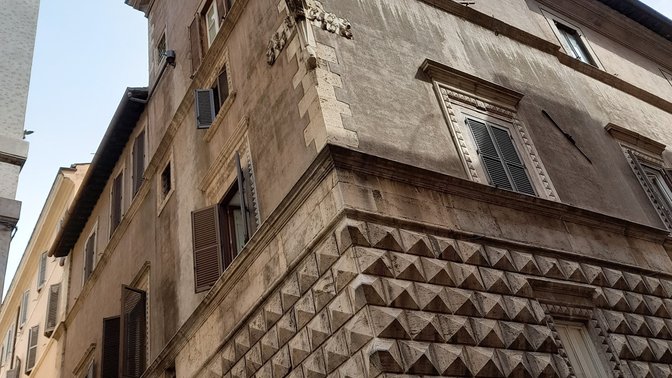
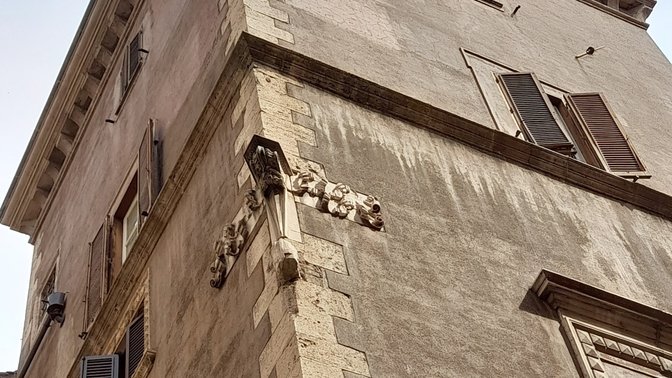
The tower soars into the sky in all its elegance and sinuosity. The upper section is made of smooth masonry, while the lower section, like the portal, is of larger diamond-pointed ashlar.
The windows are elegantly set all around the diamond-pointed ashlar, a method of facade construction, created for defensive purposes.
The tower and the diamond-pointed ashlar ensured the palace's protection, also considering that in the 16th century, the Santacroce family was feuding with other noble families and, for this reason, was disliked by the Papacy, which demolished the original building, later rebuilt in the structure we see today.