La cd "Colonna del Martirio"
Via Giovanni Giolitti, 154, 00185 Roma RM
Rating: 5.0 ★ (3 ratings)
Details
Chissà quante volte ci saremo passati davanti senza rendersene conto che dietro quella ringhiera e quei alberi c'è la Chiesa di Santa Bibiana, situata nei pressi della stazione Termini, passa veramente inosservata per via della sua posizione infelice e dalla sua stessa recinzione. È in via G. Giolitti n°154. Nella navata a sinistra è conservato…
Location
Contact
https://esploraromablog.com/2016/02/12/la-colonna-del-martirio-e-una-misteriosa-pozione-magica/#:~:text=LA%20COLONNA%20DEL%20MARTIRIO%20e%20%E2%80%9Cuna%20misteriosa%20pozione%20magica%E2%80%9D.,-Postato%20il%2012&text=%C3%88%20in%20via%20G.,per%20es
Comments
26 Sep 2024
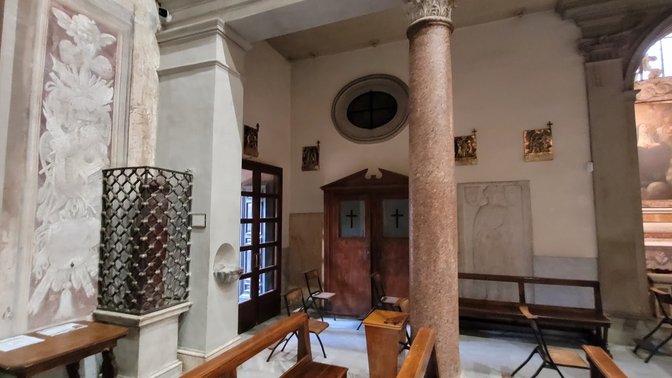
If you still have any doubts, I can assure you that a visit to the church of Santa Bibiana is not just an opportunity, but a must for any tourist visiting Rome who wants to be able to say they've seen Bernini's masterpieces (inside, in my opinion, one of his greatest artistic expressions, immortalizing the martyr with a simple yet powerful work). But that's not all: after passing through the entrance to the small church, on the left you'll notice the trunk of the column that, according to tradition, is the same one to which Saint Bibiana was tied and flogged to death with the so-called leaded flags. What remains of the red granite column appears worn by time, but also, and above all, by the scrapings of those who once removed the dust to drink it dissolved in the water of the well that once stood in the adjacent garden, along with the grass that grew on the soil soaked in the martyr's blood. Folk medicine, rich in these beliefs, held that this could produce a potion attributed with highly miraculous powers, just as was the case with the famous "wicked stone" preserved in the church of San Vito near the Arch of Galileo, reputed to combat rabies. Here too, there is another artistic marvel: the beautiful cage enclosing the column, which appears to have been designed by Bernini himself. If you discovered this place thanks to my review, leave a like... and check out all the other reviews I've written about Rome.
This church (the original one dates back to the 4th-5th century AD) was named after Saint Bibiana because, according to tradition, the family home where she was martyred along with her mother and sister stood nearby.
In 1624, the body of the Saint was discovered. For this reason, in 1628, given the building's poor condition, Pope Urban VIII commissioned the young Neapolitan architect and sculptor Gian Lorenzo Bernini (Naples 1598 - Rome 1680) to renovate it. Bernini largely restored the original appearance, starting with the façade, which he gave an early Christian touch to, the presbytery (apse and high altar), and the two chapels to its sides.
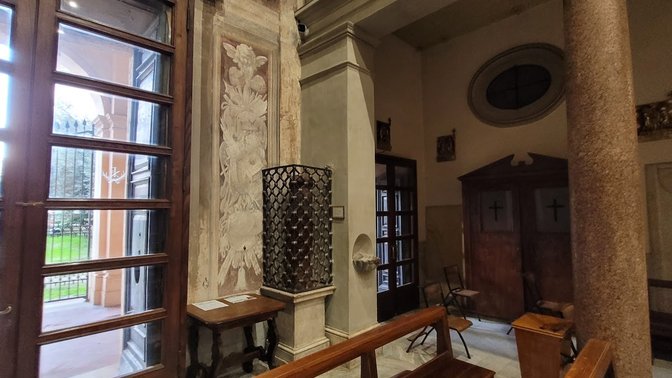
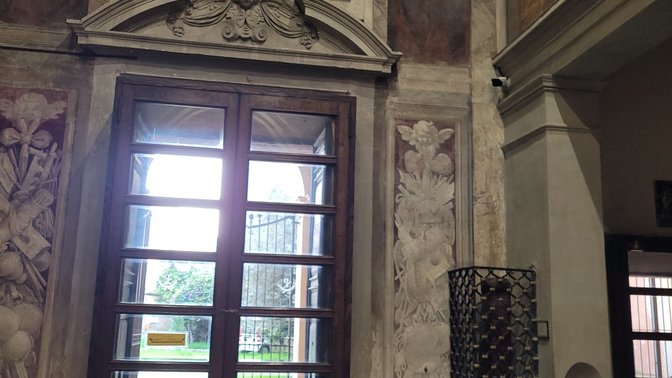
This church contains an important object of worship and devotion that has been a very important symbol for the faithful over the centuries. It is encountered as soon as one enters the church through the portal on the left. It is a column believed to be the one used for the "Martyrdom of the Saint," where she was bound and killed by flagellation because, being a Christian, she refused to convert to paganism.
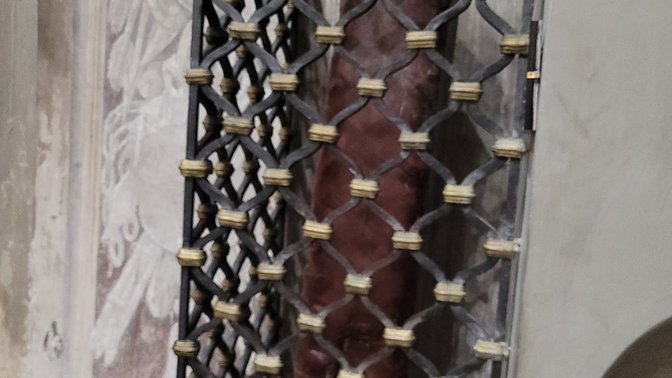
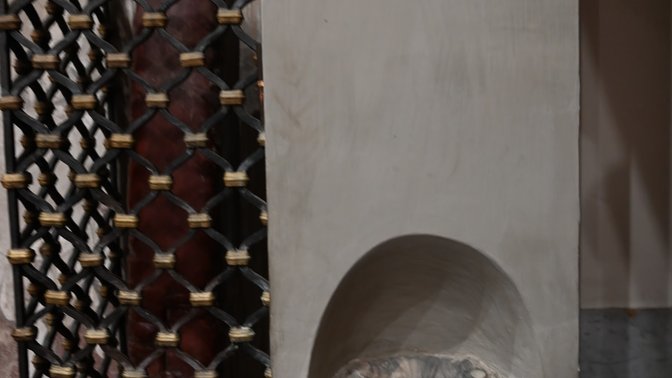
The column is made of pink marble (rosso antico) and is protected by an ornamental wrought-iron grille in the typical shape of knotted ropes (with a golden knot), designed by Bernini.
The column, although not easily visible due to the grille, is quite worn. In ancient times, the faithful would scrape off the dust and dissolve it in the water from the well in the nearby garden, making a "potion" with the herbs found there, which, according to tradition, had been soaked in the martyr's blood, attributing to it healing, if not miraculous, properties.
The Saint's feast day is December 2nd.
TRIVIA ABOUT THE STATUE OF SAINT BIBIANA
On the high altar is a statue of the young Saint Bibiana, created by the great Bernini. She is depicted just before serenely walking toward martyrdom, with her head bowed and her gaze raised hieratically. Her right arm rests on the martyr's column—a sign that the sculptor also considered it a fundamental element of iconography, having included it in the composition. Finally, with her left hand, she delicately holds a golden palm (a symbol of martyrdom).
The overall workmanship is magnificent, from the definition of the face and hands to the superb and skillful draping of the robes—a work that alone is worth a visit to this church.