Fontana dei Quattro Fiumi
Viale Adolfo Leducq, 00153 Roma RM
Rating: 5.0 ★ (5 ratings)
Details
Fontana dei Quattro Fiumi, a breathtaking Baroque masterpiece designed by Gian Lorenzo Bernini in 1651, commands the centre of Rome's vibrant Piazza Navona. This iconic fountain, a dynamic blend of architecture and sculpture, stands out as one of the city's most celebrated and photographed landmarks, enchanting visitors with its grandeur and lively atmosphere. Its prominent position in such a bustling square, filled with street artists and cafes, ensures a memorable introduction to Roman artistry and culture.
The fountain's main highlight is its colossal figures, personifying four major rivers of the then-known continents: the Nile (Africa), the Danube (Europe), the Ganges (Asia), and the Río de la Plata (Americas). Each river god is intricately sculpted, surrounded by distinctive flora and fauna from its respective region, such as the veiled head of the Nile representing its then-unknown source. A towering Egyptian obelisk, surmounted by the Pamphili family emblem of a dove, rises majestically from a rocky base, through which water dramatically cascades, creating a mesmerising visual and auditory experience.
This magnificent fountain is ideally suited for anyone with an appreciation for Baroque art, rich history, and the vibrant pulse of Roman life. It offers a spectacular backdrop for leisurely strolls, perfect for those wishing to soak up the ambiance of Piazza Navona, enjoy a coffee at a nearby cafe, or simply people-watch. Accessible at any time of day or night, the Fontana dei Quattro Fiumi provides a captivating experience, with its intricate details and flowing waters appearing particularly enchanting under evening lights, solidifying its overall appeal as an unmissable Roman attraction.
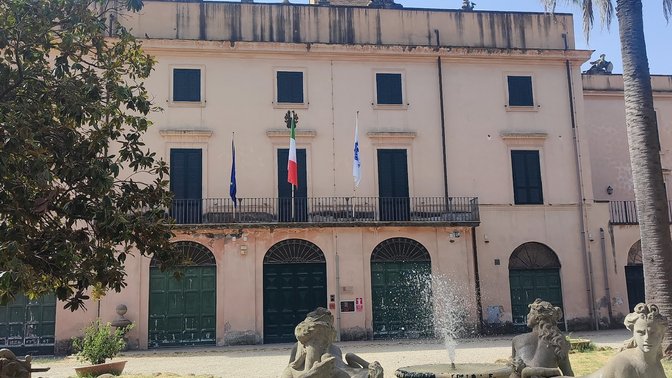
The Fountain of the Sphinxes is located in Rione XIII (Trastevere), on Viale Adolfo Leducq, in the historic Villa Sciarra in Rome.
The backdrop is the evocative Casina Borghese, which is currently the headquarters of the Italian Institute of Germanic Studies.
NEWS FOR 2025: RESTORATION AND ENHANCEMENT:
I am pleased to update the story of this place, which I have posted and reviewed several times since 2021.
In 2025, the fountain underwent a major restoration project, part of the "Caput Mundi – PNRR" project promoted by Roma Capitale.
The works included:
• Cleaning of the surfaces and removal of limescale deposits
• Restoration of the missing parts of the sculptural group
• Waterproofing of the basin to ensure its functionality
HISTORY BRIEF:
The fountain likely dates back to the first half of the 18th century.
The history of this site is much older; in fact, the Villa stands where Caesar's Gardens once stood.
The "Fountain of the Sphinxes," like others here, is a composition that has been completely reconstructed here, with particular attention to the four sculpted sandstone sphinxes.
ARCHITECTURE:
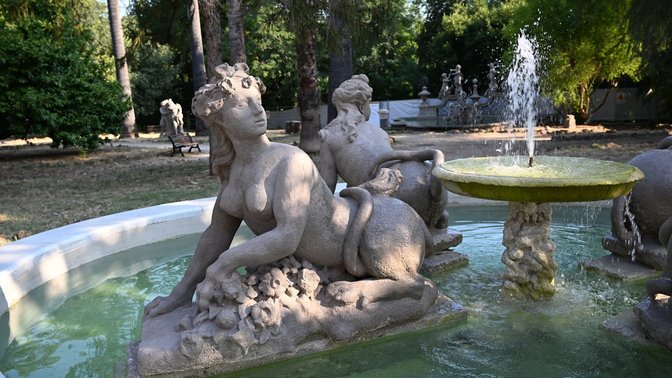
The work consists of a large oval masonry basin, with a flat travertine edge, set at ground level and over 6 meters in diameter.
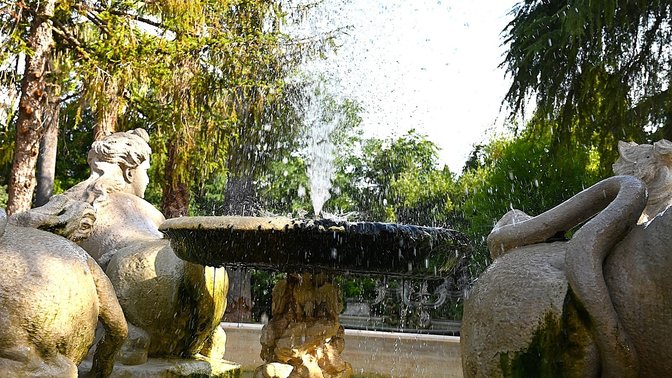
At the center is a small baluster, supporting a basin from which water gushes out and pours into the basin below.
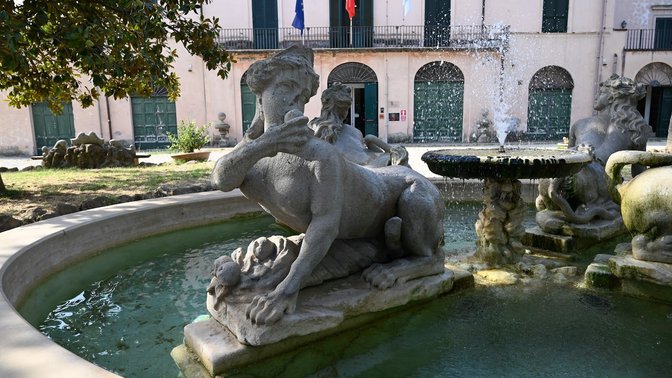
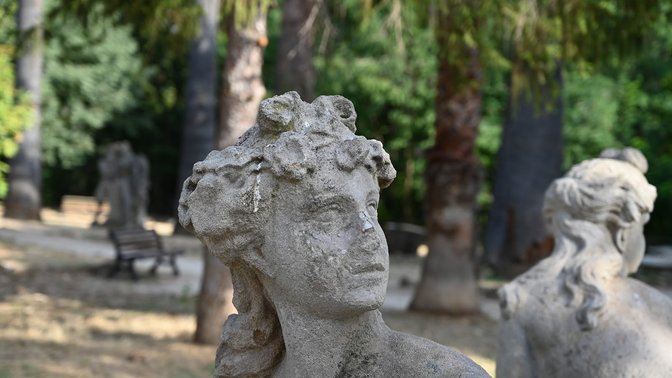
Starting from the baluster, four mythological figures representing sphinxes (over 1 meter tall) are arranged: the head of a young woman with long, wavy hair and a bare chest, a crouching leonine body, and a serpent's tail.
The Sphinxes stand on a base with their heads facing outward, arranged in an X, allegorically representing the four deadly sins:
• Anger, whose left forepaw rests on a human skull.
• Lust, resting on a large bouquet of flowers.
• Greed, resting on a cornucopia filled with precious coins.
• Gluttony (gluttony), whose large horn produces many fruits, one of which she raises to her mouth with her right paw.
FUN FACT: DID YOU KNOW THAT...?
Villa Sciarra extends over approximately 7 hectares and features:
• Palm trees, cedars, cypresses, and laurels
• Well-manicured hedges
• Artistic fountains and mythological statues
An oasis of peace and beauty, perfect for a cultural stroll.
A PERSONAL EXPERIENCE:
I'm attaching the photos of this restored fountain, which is much more than just a piece of street furniture, to this review, adding them to the previous ones, because photos speak louder than words.
A JOURNEY THROUGH THE DETAILS OF ROME:
If you're looking for a place where art, myth, and nature complement each other in harmony, Villa Sciarra and the "Fountain of the Sphinxes" are a good choice.
If this story has piqued your curiosity or excitement, I invite you to discover my other reviews.