Crypta Balbi
Via Dei Baullari, 00186 Roma RM
Rating: 5.0 ★ (5 ratings)
Details
Crypta Balbi presents an extraordinary journey into Rome's layered past, functioning as a vital component of the National Roman Museum, situated centrally between Piazza Venezia and Largo Argentina. This unique archaeological complex, originally a grand porticoed courtyard built by Lucius Cornelius Balbus in 13 BC adjacent to his theatre, served as a sheltered public space for spectators. Today, it remarkably showcases millennia of urban transformation, earning its reputation as a "lasagna of history" where ancient foundations seamlessly merge with medieval structures and more recent developments.
Visitors to Crypta Balbi can delve into its multi-level exhibition spaces, offering a comprehensive insight into Roman life across various epochs. The ground floor masterfully recounts the archaeology and history of the Balbus complex and the nearby Porticus Minucia Frumentaria, where grain was once distributed to citizens. Ascend to the upper floors to discover a fascinating array of artefacts, including frescoes, coins, ceramics, and intricate ivory pieces, illustrating daily life and urban culture from the 5th to the 10th centuries. Furthermore, exploring the subterranean archaeological area reveals the intriguing remains of the Theatre of Balbus, providing a direct connection to ancient performance spaces.
Crypta Balbi is particularly suited for those with a keen interest in urban archaeology and the nuanced historical evolution of Rome, offering a profound appreciation for how the city has been built and rebuilt over two millennia. This distinctive museum caters to visitors seeking more than just grand monuments, instead providing a detailed narrative of daily life and continuous human habitation. Its appeal lies in presenting a holistic view of Rome's rich timeline, meticulously preserving and displaying every discovered historical layer. A visit here offers a rare chance to understand the intricate social and cultural shifts that have shaped the Eternal City.
Location
Contact
http://www.sovraintendenzaroma.it/i_luoghi/roma_antica/monumenti/casa_romana_sotto_il_museo_barracco
Comments
The discovery occurred in 1899 during the construction of Corso Vittorio Emanuele, where interesting remains of a Roman domus from the late Roman Empire were found.
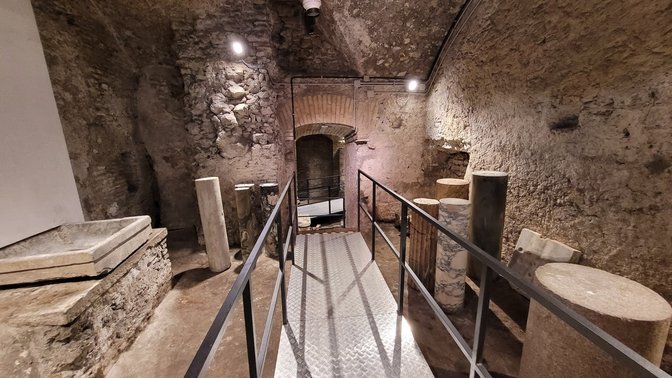
These archaeological finds are located more than 4 meters below current street level and can be reached via a staircase.
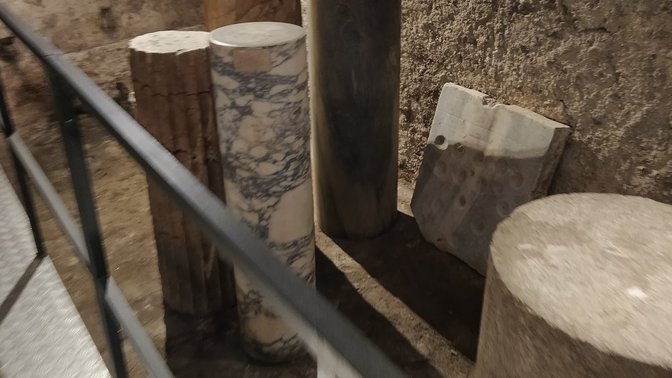
Six smooth columns (arranged in an L-shape (3+3)) are visible, belonging to the portico. The polychrome marble floor is very beautiful.
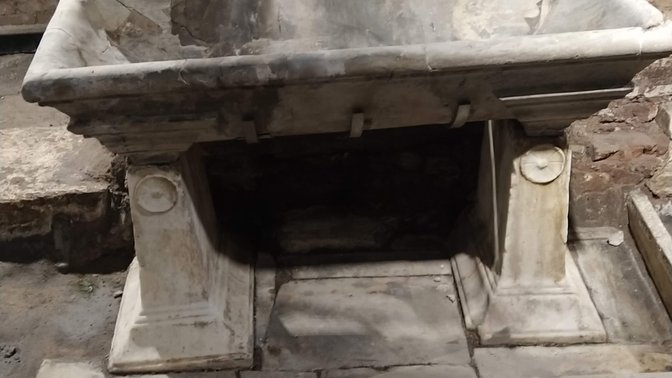
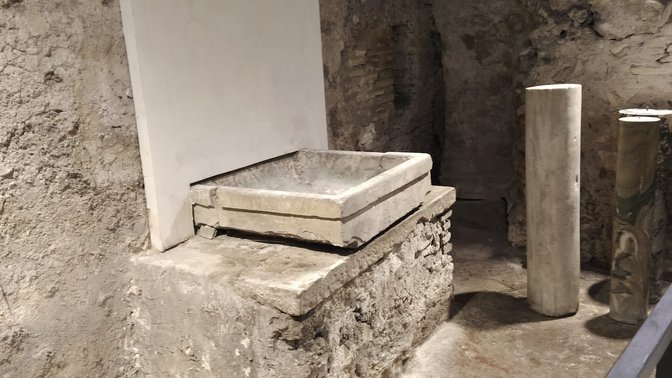
Between two columns, the remains of a room with a small basin at ground level are visible, while in another spot, a valuable larger basin rests on ornamental vertical elements with a water collection basin at ground level.
Separately, a valuable twisted marble column with an ornate capital can be seen.
It was most likely a stately building, given the large quantity of marble that furnished it. It is certainly a fascinating visit that takes us back to the glories of Ancient Rome.
The lighting is well-designed and allows for a clear view of the details of the complex. Furthermore, the visit, taking your time to read every single informational sign along the short path, can easily be completed in about twenty minutes.
Four meters below street level, visitors can step into the ancient world: a small Roman domus dating back to the 4th century AD, with part of a colonnaded portico and rooms constructed from recycled materials.
Admission is free, as is the Barracco Museum of Ancient Sculpture located above.